Conversations about responsible AI often sound like they belong in research labs and government hearings. They involve large models, global regulation and abstract principles. But most businesses using AI today face much more concrete questions. Can I paste this customer email into a chatbot? Should an algorithm help decide who gets a discount? What do I tell clients when part of their report was drafted by a machine?
These are everyday questions, and they deserve everyday answers. Responsible AI, at the scale of a typical company, is not a separate department or a lengthy policy document nobody reads. It is a handful of habits applied consistently to how data is handled, how outputs are checked and how people are informed.
01Start with your data
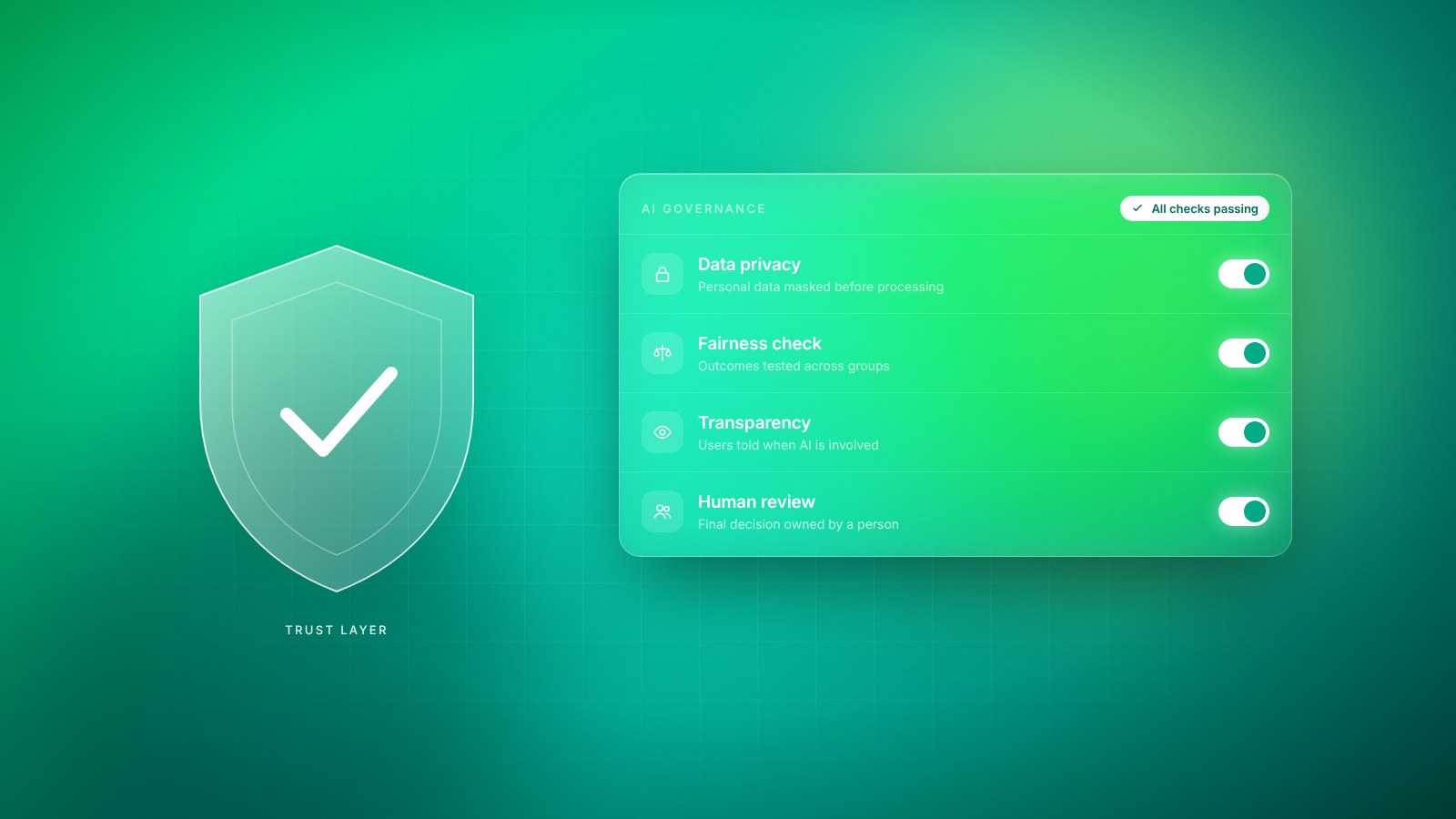
Every AI tool runs on data, and the most common responsible-AI failures start there. Staff paste confidential documents into public tools, customer records end up in places they were never meant to go, or nobody knows which system holds what. The fix starts with a simple inventory: which AI tools are in use, what kinds of information go into each, and what the provider does with that information.
- Classify information into simple tiers, such as public, internal and confidential, and decide which tiers each tool may receive.
- Read the data terms of the tools you rely on, especially whether your inputs can be used to train future models.
- Prefer business plans or configurations that keep your data private and allow deletion.
- Remove or mask personal details when they are not needed for the task.
Privacy laws in many regions already set expectations for how personal data is collected, stored and shared. AI does not suspend those rules. If anything, it makes them more important, because data can now flow into new systems with a single copy and paste.
02Check for unfair outcomes
AI systems learn from patterns in data, and data reflects the world as it was, including its imbalances. A model that screens job applications, scores leads or flags transactions can quietly treat some groups differently from others, even when nobody intended it to.
You do not need advanced statistics to catch many of these problems. Test the system with varied, realistic examples. Change one detail at a time, such as a name, an age, a neighbourhood or a writing style, and see whether the outcome changes when it should not. Review a sample of real decisions regularly, and pay particular attention to the cases the system rejects.
If you would be uncomfortable explaining a decision to the person it affects, the system making it needs a closer look.
03Be transparent with people
Trust grows when people know what is happening. Customers should know when they are talking to an automated assistant and how to reach a person. Clients should know when AI helped produce work they are paying for, and how it was reviewed. Employees should know which tools are approved and what the rules are.
Transparency also protects you. When something goes wrong, and eventually something will, an organization that has been open about its use of AI is in a far better position than one that is discovered to have been hiding it.
04Keep a human accountable
AI can draft, recommend and predict, but responsibility cannot be delegated to software. For decisions that significantly affect people, such as hiring, lending, pricing, health or legal matters, a named person should review the output and own the final call. That person needs enough time, information and authority to disagree with the system.
A common trap is the rubber stamp: a review step exists on paper, but the reviewer approves everything because the system is usually right and the queue is long. Measure how often reviewers actually change outcomes. If the answer is never, the review is probably not working.
05Working with vendors and partners
Most businesses don’t build their own AI. They use tools from providers, and those providers become part of your responsibility chain. When you adopt a new tool, ask a few direct questions: where is our data stored, who inside the provider can access it, how long is it kept, and can it be deleted on request? Ask how the provider tests its system for errors and bias, and what happens when you report a problem.
Good providers answer these questions clearly and in writing. Vague answers are a signal in themselves. It is also worth checking whether the provider’s terms allow you to meet your own obligations to customers, for example if a client asks how their information was processed.
Finally, keep a simple record of which tools are used for which purposes and who approved them. When something changes, such as a provider updating its terms or a regulator publishing new guidance, that record lets you see quickly what is affected instead of starting from scratch.
06Make it a habit, not a project
Responsible AI is not something you finish. New tools appear, existing tools change their terms, and teams find new uses every month. Revisit your inventory and policy regularly, invite staff to raise concerns without fear, and treat mistakes as information rather than embarrassments.
Done well, these habits are not a brake on innovation. They are what allow a business to adopt AI with confidence, because customers, employees and partners can see that the technology is being used carefully and in their interest.
Key takeaways
- 01Responsible AI is a set of everyday habits, not a separate project.
- 02Know what data goes into each tool, where it is stored and who can see it.
- 03Test outputs on varied, realistic cases to catch unfair or inconsistent results.
- 04Tell people when AI is involved and keep a human accountable for important decisions.